Saturday, September 19, 2009

Road Trip Argentina

Upon arriving in Argentina, we had a quick visit to La Plata to do our paperwork, and then spent 2 weeks in Buenos Aires. Following that, we moved the boat to a place called Tigre, where we left it and hired a car and drove around the country for 5 weeks. This is an account of our Road Trip around Argentina, including our 3 weeks in the beautiful Bariloche. I have skipped a recount of Buenos Aires, which will still follow. This account is from when we left the boat in Tigre until our return 5 weeks later.

Road Trip Argentina - Tigre, Buenos Aires to Mendoza (1200km)
We left Tigre Buenos Aires at 2pm after an epic session of packing the car. The epic was more to do with the fact that there was no water in the river where we had parked the boat. We woke up to see that just about all the water had departed. From where we are moored, it is 100 metres to the club jetty, then across the Rio Lujan to Tigre town is about another 400 metres or so. Normally the lancha (launch)and Pablo arrive from the club comes and picks you up from the boat, and then drops you off at either at the club or on the other side of the river in town.

So Andrew had to paddle our leaking dinghy to the club (the water was about one foot deep – so no wonder the lancha could not get to us), borrow a canoe, and paddle the bags across to the club one by one until finally, after about 6 trips, us , and all of our luggage were ready to catch the lancha across the river to pack the car. What a palaver! All in a days living on a boat I guess! The other challenge was we were not very sure if we would fit into the car with all our luggage, but somehow Mum and Rupert performed a magic trick, and with 2 bags lashed to the roof with spare rope we were off.
Our next challenge was leaving Tigre itself! The roads are bad, but the signposting is appalling. Actually, that is not true, it would have to be there to be appalling; in most cases, it is just non-existent, which makes for very interesting navigating. Generally one spots a road, and tries to find it on the map, which may or may not happen, and then tries to find the next road marking that may give you some sort of idea which way to turn. A lot of road navigation has to do with the sun, and you just try and tend in the direction you are ultimately hoping to go, and you may or may not find the main Ruta you are looking for. Alternatively you are compelled into taking a desvio (diversion) for roadworks and seeing another, sometimes interesting, or sometimes not – part of town! Of course there is the option of hiring a GPS with the car, but that would take all the fun out of it now wouldn’t it ;-). So after an hour and a half, we finally stumbled upon the highway, after doing a grand total of 65 kilometres.
The countryside out of Buenos Aires is completely flat, and as well as the enormous beef herds, there are small pieces of land that are filled with all sorts of live stock – donkeys; fat, enormous pigs; and hundreds and hundreds of horses of all types. If we ended up living in Argentina, I would love to breed and school children’s ponies and send them to the UK. There just seem to be hundreds and hundreds of exactly the type of pony that people are always battling to find – steady, sound, strong boned, reliable, and good looking. If anyone is wondering where all those ponies are, they are right here!
Driving across the country, there is a random enormous billboard advertising the Alas Hotel – rather apt.
A big old Mercedes bus was parked by the side of the road for sale – looks perfect for us if we decided to trade in the boat and go for the land based travel option!!
In the dusk last night there were hundreds and hundreds of birds flying in to roost. I have never seen so many birds in the sky at one time, fantastic against the setting sun and dark silhouettes of the bare branches of the winter trees.
We stayed in a place called Junin the first night in a rather fancy hotel – of the same ilk as the South African (or rather worldwide I guess) Holiday Inn. Very reasonable, for all 4 of us, it was 500 pesos, which is R1000 and includes breakfast. A little more than we were planning on spending every night, but as it was the first time we had been in a hotel for 7 months, we thought we would treat ourselves. Lucy thought it was Christmas, space to run around in, especially after being cooped up in a car seat all day, and even better a telephone to play with all of her own – luckily we could unplug it, otherwise I think reception would have been quite busy keeping up with Lucy. She has been extraordinarily good in the car, with very little fuss, although she definitely has an ongoing entertainer, who tries to keep her interested in games of building blocks, colouring, roaring lions, galloping horses and “dugga-dugging” cars! Then if all else fails, ipods, cellphones and the ever entertaining duo of Peppa Pig and Shaun the Sheep DVDs normally do the trick. Thank goodness, as we were not at all sure how she was going to cope with being in the car, and if she was going to put up with being strapped in the car seat for hours on end, but thankfully, she seems to be taking it all in her stride.The next day, after leaving Junin and after driving for about half an hour, we have crossed some salt pans with the most extraordinary bright pink flamingos – hundreds and hundreds of them in the morning sunlight with iridescent pink wings – what a lovely way to start the morning.
Lots of Estancia Chica’s (small farms) full of shining fat herds of cows. Peculiar little houses tucked away in small groves of trees, one we have just driven past was 3 little pink A – frames in white and rust brick. Scores of birds, in particular small birds of prey, mostly unidentifiable.
The Ruta 7 that we are traveling on is one of 2 main routes across the country from Buenos Aires to Mendoza, we chose this route as apparently it has less truck traffic. The other route must be horrific, as this route is not a very wide road at all, and has a lot of truck traffic, and they are not small trucks, they are big 16 wheel or more, many with trailers. Thank goodness the car we have hired is up to the job, a little Ford Ecosport, which has a nice wide wheel base so is firm on the road, which is really important when you have to deal with crosswinds after every truck. We are only traveling during the day, as the night, the roads are far too dangerous, and also of course for Lucy’s sake.
The landscape so far is remarkable in its’ unremarkableness!It is completely flat, and just goes on forever, in saying that – we have just driven past an Estancia called La Differencia – although I am not sure what exactly that Difference would be!
The side of the road is dotted with various truck stops, many of the home grown parilla (braai or barbeque) variety, though I am not sure if I would really want to eat a choripan (boerie-roll) from any of them!
The road crosses more salt flats, absolutely amazing, hundreds more flamingos, storks, huge birds of prey – unfortunately, we cannot stop, as the road has barriers alongside, no verge, and no viewing places! I guess we will have to make do with fleeting shots through the window.
For lunch we came upon the most unexpected Parillada, there were lots of cars parked outside, which is always a good sign, and we went into a wonderful, old restaurant with a roaring parilla in the centre and a very amenable salad bar. The owner who came and served us was extremely friendly, and when brought our order of drinks, we were slightly amazed. We had asked for a agua sin gas (water no gas), agua con gas (water with gas), a pepsi and a cerveza (beer). What arrived was a litre and a half of each, alongside my agua con gas, which was an old soda siphon, complete with little tap to decant my glass of agua – absolutely brilliant. The food was excellent, and we all were ready for the road ahead to Mendoza with full stomachs.
Driving into the province of Mendoza, we drove through a state border control post and were welcomed by a 5 minute onslaught from a local tout trying to sell us a room at his hotel. This all happened about 5 metres before the official security check, who looked on while the tout spent about 5 minutes expounding upon the merits of his particular hotel, while the queue of traffic piled up behind us. I guess maybe there is some sort of mutual gratuity between the 2 parties. When our tout had finished his presentation, we drove through the security and then finally through a ‘De-insectacion’ for the vehicle, so I guess they are not too keen on bringing other Argentinian bugs into this province. Understandable, as this is the province of ‘Sol y Vino’ – or Sun and Wine, and I should think that protecting the precious vines from any dreaded lurgies that may come into the province on wheels is very important.
The landscape changes again and the vineyards became the prominent feature, looking very similar to the winelands at home in winter, very brown and dormant.
In Mendoza, we decided upon the Hotel Argentino (there is one in every town, though they are not a chain), which is on the main Plaza Independencia (of which there is also one in every town), which is just off Avenida Sarmiento (which of course, there is also one in every town, along with 9 Julio and 25 Mayo!) The Plaza is magnificent, with an incredible floodlit fountain, park benches, huge old trees and a night time market that add to the ambience that bring lovers and families alike to spend their time.
We spent 2 nights in Mendoza, which gave us a day to make use of. We decided to drive into the Andes and see if we could reach the snowline and hopefully even get a glimpse of Aconcagua, the highest mountain outside of Asia. Once we had finally found the road after a dozen or so false starts, we made our way though a nature reserve up a very narrow, dirt mountain pass.
It was definitely the scenic route, as the thin dirt road wended its’ way upward, soaring birds of prey, isolated retreats and herds of lamas looking out from the hilltops.
The views were spectacular. In the distance the snow covered peaks of the Andes still beckoned. We kept going upwards, gaining height quickly, easy to tell when we got out the car, as we were puffing for breath after even a short walk due to the altitude.We kept driving, passing a site with a Darwin memorial, (it was here that he discovered the araucaria tree, or monkey puzzle).We were wondering if we would ever get to the top of the pass, when we drove over a small rise and all gasped in simultaneous awe as our vision was filled with snow covered mountains as far as the eye could see.Absolutely flabbergasting views. The vista that you see in books and go – “oh wow”, and then you see them with your own eyes, you realize why you travel, because the pictures you see in the coffee table books can never be felt, however good the photographer.
So we then spent the rest of the day driving through the most magnificent mountain range, covered in snow, stopping to drink in the vistas, and to refuel our bodies with glorious hot chocolate.Driving up through the snow covered mountains, the snow getting thicker beside the road every kilometre, it was unbelievable to see the Andes in their snow covered glory at such close quarters. The pass travels through to the Chilean border, but we stopped short of that at the viewing point for Aconcagua, but unfortunately, we could only see the snow blowing off the top, as the weather was covering the mountain.On the way down the pass, we passed the line of trucks awaiting the trip across the Andes into Chile, it looked like the pass had been closed as the line of trucks stretched for 5 km, I have never seen so many stationary trucks in my life!

Road Trip Argentina – Mendoza – Bariloche (1200km)
After leaving Mendoza, our next stop was Chos Malaal, which was an epic 750km into Patagonia on the “mystical” (according to the Lonely Planet) Ruta 40. A lot of the road is gravel, and not particularly great gravel, filled with holes, ruts, corrugations and loose stone. An amazing days’ journey, spectacular, mind opening, landscapes ready to fill the spaces in the imagination of years of what Patagonia really looks like.
One contemplates with awe this land being concertinaed into the hills and mountains over the years. It is difficult to imagine the time period though, as it looks like it happened over night!
The landscape is littered with extinct volcanoes, and apparently we have driven past some hot springs that emerge at the volcanoes foot, but we missed the turnoff.

It is so easy to imagine the dinosaurs roaming here, you can just see a clutch of baby dinosaurs hatching out of their eggs that have been buried in the side of a mountain, finally being exposed to the sun as the piece of earth surrounding then is eroded, and they emerge, blinking, shaking off a few stones and dust and trot off, as if no time had passed at all.
Gauchos (cowboys) are seen intermittently riding across the landscape, sometimes alone, sometimes with packs of dogs, and sometimes with their herds/flocks of sheep, goats, lamas or horses. Looking every part like one imagines, with cowboy style hat, big comfortable leather saddles, warm layers of lama wool clothing and leather coats, boots and sun baked faces.
Then you come upon a random set of railway bridge pieces piled up by the side of the road – used, or never put to use, who is to know.
We left Chos Malal for Bariloche, so we have another day of remarkable scenery to look forward to. The scenery is again breathtaking. The striations running through the hills literally reach across the entire landscape. The folds in the hills look like icing on a cake but the colours are of the earth. Brown, green, ochre, red and every colour inbetween. There are rock faces that have been created where entire hills have been blown away by the harsh winds that blow here incessantly.
We are finally into the last 100 kilometres of the trip, and it is difficult to imagine the pictures of Bariloche being so close, as the landscape gives nothing away yet. Then the hills start to roll, and the cliffs appear. And we drive into a valley that takes your breathe away, even though all we want to do is get there now, we stop for the obligatory photo opportunity, though in hindsight if we had any idea of what we were still going to see, I think we probably would not have bothered with the stop!It is really cold, and it has just started to rain, there is snow lying on the sides of the road, and the wind is blowing strongly. Bbrrr, but very very beautiful.
When we drove into Bariloche, we drove straight up to the ski resort, which was really amazing to look at, snow on the sides of the roads as we got closer to Cerro Catedral, the trees dripping white – all looking very optimistic for a good skiing holiday. Unfortunately, that was the best snow we were to see while we were in Bariloche. The existing snow melted as every day we waited for more to fall. We were hoping to learn our new skills on the lower slopes of the mountain, on the cheap snow, but the only snow we were to see while we were in Bariloche was on the high peaks, which we eventually went to find after a week of frustration.

Nordic Skiing
While we were waiting for the snow to arrive on Cerro Catedral, we investigated some of the smaller surrounding mountains, the closest and most interesting, along with easily accessible was Cerro Otto, set just behind our cabanas. It was a short trip up to the top where we found the most charming log cabin which was the home base for the centre of Nordic (or cross-country) skiing – most curious indeed. So in the absence of the snow that we so desperately wanted to fall, we took advantage of what was lying on the ground and signed up for a lesson with our Ukrainian ski instructor Valerie.Nordic skiing is another name for cross country skiing, you may have seen it at the winter Olympics…. It looks like running on snow – well, that is what it is supposed to look like anyhow. I think it is quite likely that we looked quite different from that! – with Nordic skiing, unlike conventional downhill skiing, you have only a very thin ski, and no supportive boots, only a thin pair of leather boots perched on top, with a very simple toe clip. The result of this is of course, that you are far more precariously perched on top. And while with downhill skiing, once you have the basic skill, falling forward or sideways is quite difficult,
With Nordic skiing, falling anyway anyhow is pretty much standard! We had a great time with our ski instructor, who was very patient with our crew with their various levels of competency, with Andrew and Rupert leaping off snow banks by the end of the afternoon, while my Mom and I went for the glorious hot chocolate option in the cozy log cabin after tiring of falling on our derrieres, amongst other bits of our anatomy – yet again!
The surrounds of Bariloche are just too glorious to be real, as the evergreen forests fall into melt water lakes, with yellow reeds at the water’s edge just adding to the picture postcard feel (actually there are a few sets of postcards here, it is really just too much for words to describe).
The views physically leave you breathless, which I have only experienced a few times in my life before – and it is then normally once, not around every corner. We took many day excursions to the areas surrounding Bariloche: Villa de Angostura, El Bolson, Mount Tronador in the protected part of the Nahuel Huapi National Park, and the extraordinary Llao Llao Hotel.

Skiing
Our skiing was interesting to say the least – not quite what we had in mind when we first thought about skiing in Bariloche.
We were there for 3 weeks and it snowed once, then just after we left it snowed hugely! Anyhow – we tried to make the best of it!The boys decided to go the snowboarding route and chose after seeing the prices of the lessons that they did not need lessons and were just going to download some instructions off the internet. This in true Andrew style was massively entertaining as we watched him try and read a printed off sheet while trying to snowboard down a mountain.
Well not quite that bad, but not far off. But in more true Andrew style, both Rupe and Andrew got the hang of things pretty quickly, though not without falling with that snowboard at least 100 times a piece! Mum and I decided to go the ski route, and we decided to pay the price and went for a couple of lessons, which were very helpful. The problem was that as there had been no new snow, all the baby slopes were very icy and pretty slippery, and of course absolutely packed, as there were only a very few at the top of the mountain.
We decided on our last day (after just a couple of days of feeling vaguely competent that we should at least try to ski down the mountain once – this was completely terrifying, as the first part of the slopes were all icy, and by the time we got there, getting worse as it was later in the afternoon! I went down quite a lot of that on my bottom! Once we got to the contour path, the going was much more in my comfort zone, and I absolutely loved coming down. I was pretty disappointed that we did not manage to do more skiing, but I guess it just means we will have to go back!

Villa de Angostura
Smaller than Bariloche, Angostura is the ‘smart end of town’ full of wooden buildings of all shape and description. The general architecture gives you a feeling of being somewhere in the swiss alps, not southern Argentina. We did not stop in the village itself, but drove down to the small port. It was really cold so we decided to enjoy the surroundings from inside a little family run restaurant we found, nestled under the trees.

The fare we sampled was excellent, the best hot chocolate we have tried yet, Andrew enjoyed a guiso – which is a type of local stew with lentils and meat – proper cold weather food. I had the most excellent trucha al limon (there are lots of trout hatcheries around this area), and Mum had a type of shepherds pie thingy. The food did not disappoint, and we all went away with nice full bellies!
Hotel Llao Llao
We visited an amazing old hotel, that is was really like something from another era altogether – well I suppose that is exactly what it is!
You walk in the door and two classic dog bronzes welcome you in the entrance hall, their heads polished by hands greeting them with a rub.

You walk down a wide staircase, with brass carpet rods keeping them in place. Huge antler chandeliers bedecked the double volume ceilings and the reindeer covered highbacked chairs decorated the tea room, awaiting our visit. The hotel also had a window that looked out on Mount Tronador, the largest peak in the area. The architect having framed the mountain perfectly with a huge window looking out from one of the many restaurants in the hotel.
We enjoyed a late afternoon tea and scones while Lucy became best friends with the 2 brass dogs, and kept giving them big hugs and kisses!

Nahuel Huapi National Park
Today we took a drive to the Nahuel Hapi National Park, the views were again extraordinary, it becomes very difficult not to become blasé when day after day you see new sights of possibly the most beautiful landscapes you have seen in your whole life.Well today was definitely another day of wow, I have never seen landscapes like this before today. The lakes of melt water that surround this area (there are dozens), are so crystal clear, the colour of the lakes is an aquamarine, teal blue, depending of course on the sunlight and the way the wind is blowing, and if there are clouds or mountains casting their shadows across the water. The forests have been there since the dinosaurs, and look like something out of Lord of the Rings, with huge thick evergreen forests stretching on and on, the rocks covered with moss and trees draped with lichen.

The sun shining through the canopy and catching the shiny side of the leaves, casting shadows that make you believe that around the next corner you will find a pixie skipping across the road. It is just jaw droppingly beautiful, and leaves that wondrous feeling of awe, that makes you just want to stop and look at the view all day.

Chocolate
Bariloche is well known for it's chocolate, and with good reason. There are chocolate shops everywhere and hot chocolate to die for, rich, and creamy, it really just tastes like liquid chocolate instead of chocolate powder and water which is the normal case. We of course had to go on a chocolate crawl, and managed to visit 5 chocolate shops one day before crawling home with our loot. This was what we ended up with each, and no, none of us managed to finish our plates the first sitting!
Road Trip Argentina - Bariloche to Peninsula Valdes (1000km)
We leave Bariloche, and are heading for the Atlantic ocean. Our destination is Puerto Madryn National Park to see whales and sea lions. The first day’s trip was through the mountains, icy passes and clear mountain rivers and streams. The winter colours are remarkable in their richness, the rose hips and berries adding red and orange highlights to the palette of autumn colours that painted our views.The extreme temperatures that the roads endure clearly take their toll, with constant road maintenance not being a sufficient stem to rapid deterioration. A boulder tumbled across the road to remind us who was here first! We stopped for supper at a small town called El Bolson, and then headed on to Esquel to find some basic beds to rest on before the 700km across Patagonia that we had planned for the next day.
Driving across a huge valley with a wide river running through it. We are driving down one side, and close to the eroded rock faces that look just like castle walls, as the lower layers of softer rock have been blown away by the winds, leaving the tops remaining as turrets. The river brings life back to the wind swept landscape, and Poplar and Willow trees hug the banks and drape their branches into the water. Ponies of all sizes and colours graze along with cattle and sheep, with some new, early lambs playing ….
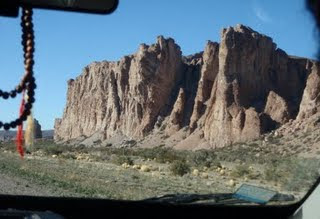
The region is obviously known for it’s geology and variation of rock types, as we have passed various signs advertising rocks of the area for sale.
The size of the landscape is completely mind blowing, as we drive on for hours, and it just goes on and on and on, and just changes again and again, which is difficult to believe, as you kind of think, oh well I have seen it all, and then you go around the corner, and you are faced with a pink cliff of rock, with the sunlight bringing out all the colour, and you just blink, not believing there are more new things for you to see.
The rock changes again, and the striations run vertically, covered in green oxidised copper, creating hundreds of towers of rock. Lamas scattered at the feet, browsing the Patagonian shrubbery for berries and tasty treats.
The local specialities of ciervo (deer), jabali (wild boar), trucha (trout) and Patagonian cordero (lamb), are served in many restaurants. The taste of the Patagonian vegetation is apparent in every mouthful of succulent lamb that melts in your mouth.

Puerto Madryn and Peninsula Valdes
We arrived in Puerto Madryn and were immediately met by whales in the bay, which boded well for our visit there. We drove through from Puerto Madryn into the Peninsula Valdes Reserve, and booked ourselves into a rather larney hotel called La Restinga. The only hotel right on the beach. We could see the whales breaching while we got dressed in the morning, and while drinking our coffee. Life could be worse!
We drove around the Peninsula, which is much larger than one envisages in search of elephant seals and orcas, but rather sadly it seemed like we had planned our visit just a couple of weeks too soon. The elephant seals, which number in their thousands when they arrive in August, were nowhere to be seen, just a single, solitary animal, holding the fort until the others arrived back to breed in the season. The orcas where a similar story, the closest we got to a viewing was the page of calendar that the park ranger tore out of his February calendar to give to Lucy which noted the Orca sitings for last February!!
We were not to be put off, we thoroughly enjoyed seeing the rheas, maras and guanacosin their natural environment, and were determined to make the most of the whales that were teeming in the bay. The following day we went out with one of the local whale watching companies and had a wonderful morning watching these gentle animals at such close quarters. Even though we get to see a lot of whales back home in South Africa, they are just impossible to tire of, watching them play and court in the waters around the boat, knowing that with just one flick, they could easily overturn your 10 metre boat with all its’ occupants, certainly adds an edge to the experience.Of course, they never do, as they are such very gentle giants, and don’t seem the slightest bit interested in us which adds even more to their magical charm.

Road Trip Argentina - Peninsula Valdes to Buenos Aires (1300km)
We were now in the home stretch, and there was not much to stop us trying to get back with as little stopping as possible. We did find one interesting town, where we stopped over en route back – which was a place called Las Grutas – or The Caves. This is a place on the coast where the sea has created caves in the cliffs at the back of the beach which are a perfect habitat for a particular type of parrot. Flocks of this noisy and colourful birds came into roost as we enjoyed the last of the light. A pod of dusky dolphins playing in the surf added to the ambience of the walk along the beach, and amazing man made pools reflected the setting sun.This was the only really interesting place on this home stretch drive, and other than sleepy towns and lots of trucks, we were all keen to get back to the boat and to see if we would be able to dig our way out of the mud at Tigre Sailing Club!

Thursday, July 9, 2009

Colonia del Sacramento by Granny Jo


Colonia del Sacramento by Granny Jo

Colonia del Sacramento is the jewel in the crown of Uruguay's tourist attractions, and is a World Heritage Site. It is situated in south west Uruguay on the River Plate.

The original settlement was founded by Manuel de Lobo, a Portuguese, in 1680 to enable them to smuggle goods across the Rio de la Plata into Buenos Aires. The Spanish took the town in 1762 and it remained in their hands until 1777 when tax reforms made smuggling redundant.

Today the main port is a busy terminal for the Buquebus ferry service to and from Argentina. Colonia is a popular weekend destination for Argentineans. The old port is now a favoured stopping off point for weekend sailing jaunts & races from Buenos Aires and for cruisers (the yachting variety) like us. It is ideally situated in the old part of Colonia and once off the boat you are right in the historic part of the town.

The old town is beautiful, we visited it on a weekday in winter & it was very quiet which gave it a slightly dead feel. I'm sure that it feels livlier when the summer crowds throng the streets.

The prettiest part of the old town is around the 'Plaza Mayor 25 de Mayo'. Many of the streets in Uruguay are named after significant dates '18 de Julio' is another popular choice, almost every town seems to have one of these. If it's not a date it is usually a General or a South American country.

The architecture is, unsurprisingly, typically Portuguese/Spanish. A lot of it is single storey with flat or shallow pitched terra cotta tiled roofs, with only the grander residences and some later commercial buildings such as warehouses, rising to a second floor. There are two obvious exceptions to this, the lighthouse and the windmill. The streets are all cobbled; some have a central gutter, and some have the high point in the centre of the street with a gutter on either side. I understand that one is Portuguese & one Spanish but I cannot remember which is which.

The Plaza Mayor 25 de Mayo is rectangular and generously proportioned, lined on either side with citrus trees, the central grassed area has a collection of large trees providing shade and a few tall palm trees full of noisy Parakeets. Fronting onto the square are various official buildings such as Admiral Brown's house (whoever he was); a beautifully proportioned double storey house painted white with green shutters and door; the Armada (navy) offices and a few merchants’ houses. The lighthouse stands in the southwest corner adjacent to the ruins of a monastery. At the opposite end are the remains of the original wall of the fortified settlement with a drawbridge. A huge Uruguayan flag flies in the square; the Uruguayans are proud of their flag and take every opportunity to show it off.

There are old Bougainvilleas growing throughout the old town and they add a colourful dimension to the streets and squares. Many of the wider streets are lined with trees, often Plane trees to my surprise; I always associate them with London. To add to the vintage feel of the town there are numerous old cars parked in strategic spots around the old town, we saw a Model T Ford and an ancient Citroen to name two. It is commonplace to see very old cars on the road in Uruguay as new cars are very expensive so models of thirty years old and more are unexceptional.

There are still quite a lot of old buildings that are as yet unrestored, I imagine that this is due to economic reasons as the old warehouses adjacent to the port are large and quite dilapidated and would require significant investment to bring them back into use, some of them would make amazing boutique hotels or apartments. The fact that these buildings are not in use does not really detract from the atmosphere of the old town.

The town has lots of coffee shops and restaurants, most of them a cut above the standard we have found in other parts of Uruguay. One in particular had beautiful magazines and shelves of art books plus a bookcase with most of the quality bestsellers from the last ten years or so, all in English. They were there to read in the coffee shop, not to purchase. I wish that we had stayed long enough to have read some of them. All this and great coffee, free wi-fi , an open fire and a great view too.


The greater part of Colonia is a fairly ordinary Uruguayan town, wide streets and a large attractive central square. Most buildings look a bit run down but must have been quite smart in their time; a lot of the architecture is of the Art Deco period. It is a strange contrast to the elegant historic town.

Wednesday, July 8, 2009

Goodbye Piriapolis, Hello Monte Video

Piriapolis 3

Paella - by Andrew

One morning, while walking Lucy along the harbour wall to feed the cats,

I noticed a shell about the size of a fist stuck to a rock about half a metre under the surface. I pulled it out, and saw it was the same as the one Paulet had shown me at the oyster farm in Florianopolis. I remembered too that he, as well as his staff, were effusive in their praise of its gastronomical value. Back on the boat, I boiled it until it frothed, then yanked it out of its shell with a screwdriver and bit into it. Not bad at all. In fact it was quite rich. So without further ado, I co-opted Rupert and together we dived off the seawall with gloves and a net bag, and harvested fifty seven more. For good measure we also collected a large pot of mussels. That afternoon, after scrubbing the shells, I boiled and cut up the whelks while Rupert cooked the mussels up with rice and some vegetables, and we all sat down to a large paella. It was delicious – and free!

Leaving - Piriapolis
So finally after 3 months, we leave Piriapolis, it was quite a strange sensation casting off, because it has become home. So strange what happens when you travel and then you stop, I can see how easy it is for people to stay in a place for long periods. We have met the most amazing people, made real friends, and experienced life in Uruguay. We had a fairly large leaving party waving us off from the port, which is quite unusual for a cruising boat! We left with mixed feelings as goodbyes are always sad, but we are definately ready to see new shores.

Isla de Las Flores (An island on the way from Piriapolis to Monte Video)
Our friend Eduardo from Monte Video who is also a sailor, has some contacts on an island just off Monte Video called Isla de Las Flores, this was an old quarantine island and political prison. One has to get special permission to visit the island, so it was great that we were able to just arrive with Eduardo. When we left Piriapolis, we planned to meet Edo there for an Assado on the boat, and then moor in the small harbour at the island, spend the night, visit the island in the morning and then leave the next morning for Monte Video. However, of course, things did not go according to the plan exactly! Now there is a suprise... We left Piriapolis later than anticipated, so after casting off at 2pm, we motored on very flat waters (no complaining from this department), and reached the island at 8pm, of course it is then dark, so it is not a great time to reach a new anchorage, and the wind was starting to pick up. The island itself looked incredibly dramatic at night, as it has a very large light house on it, which flashes it's beam strongly across the water, warning all those of it's shallows and rocks. On arriving there was no sin of Edo, which was a little dissapointing, but not suprising as we were about 4 hours later then the original plan! We peered into the diminutive harbour with our meagre flashlight, but definately no Edo inside. Edo sailed a beautiful boat that goes by the name Yamandu, who is the mistress of the sea, she was built in 1937, so is very special, and is the most sailed boat of that age in the Rio de la Plata. We decided to anchor for the night and then make our way to Buseo in the morning. Not 5 minutes later, whilst finding a suitable anchor site, the sails of Yamandu loom out of the dark! Yay, Edo made it, it seems he had as much drama leaving Buseo as we did leaving Piriapolis. He was recalled once for work, and a second time by the Prefectura for some incorrect radio protocol! So in the end, completely independently we arrive at the same place within moments of each other, which was 4 hours different from the original arrangement! Edo hopped on board, we tied Yamandu astern of Josephine, and we proceeded to have a slapup braai/assado with fantastic cativelli chorizo's and a great piece of steak.. Nyummm.

By now the wind had picked up quite a bit and we were being blown onto the island, the anchorage was really bumpy, and it was too difficult to see to get into harbour, it turns out that was the right decision, as the harbour did not have enough water for Jospehine anyway. The anchor started to drag, so we moved further off shore, where it happened again. We then moved the boat around to the lee of the island, were we managed to anchor successfully until the morning with the 3 boys doing an anchor watch to ensure we did not drift off into the deep blue sea while we were sleeping.

With the morning light, the wind dropped off competely, and we had a beautiful view of the island, the black rocks covered in gulls, the white lighthouse, derelict old buildings and grey sky making an impressive picture.


After coffee and a matte, Edo then hopped back onto Yamandu, and we motored back around the island to the harbour, where we tied up against the outside of the harbour wall, while Yamandu moored inside, her draft allowing her inside easily. We were welcomed by the 2 sole inhabitants of the island, who run the lighthouse, and take visitors around. We then toured the island, which was fascinating, with it's old buildings and stories of quarantine - the remains of most of the buildings still stand, which were built 150 years ago. The island housed all immigrants to Uruguay, both rich and poor, for a short period while they were in quarantine, so as to ensure they did not carry any foreign diseases into the country. So there is a very dramatic building, which must have been awfully posh in it's time, were all the rich stayed, and very basic housing for the poor. It also housed political prisoners, who had an apartment like 'cell' with 2 floors and a sea view. The old boilers and massive pressure cookers are still standing on the island which were used to boil and sterilise all the clothes and belongings of the immigrants. Amazing to still see these relics standing on this barren little island. The island was teeming with birds, mostly gulls, but we saw quite a few pairs of oyster catchers too, unlike our plain black oyster catchers, they were pied, but had the same distinctive beaks and calls.

On our way around the island, Lucy was doing her usual charming of the guides, who then offered us the option of having an assado on the island, which according to Edo, is completely unheard off! We gleefully took them up on their offer, and cooked up another storm of sausage and meat, luckily we had plenty left over, due to over catering the day before! So while the steak cooked on a grid that the fisherman use when stranded on the island by bad weather, the boys hoofed around a rugby ball in the court yard. Lucy discovered some toads hibernating amongst some dwarf squashes, that had never grown due to lack of water. She thought the baby squashes were more interesting than the toads thank goodness, and we even managed to frighten a rabbit across the courtyard whilst we were enjoying our meat. What an extraordinary day, we thoroughly enjoyed Piri, but it is really great to be on the road (so to speak) again, seeing fantastic new things, and experiencing these magic interludes which one could never dream up as hard as you tried!


So back on the boat, and off we head to Buseo, Monte Video. Hmmnn, technical hitch - the engine won't start! Oh blimey, now what - flat batteries? Hmmn, we did leave the fridge on throughout our assado... Thank goodness for small mercies, our dear friend Edo is an electrician! Edo to the rescue, I am sure Andrew and Rupert would have got to the bottom of the problem, but it was an awful lot quicker with Edo at hand! Great stuff.. very happy, So Monte Video here we come..

Monte Video - General
We had a very pleasant stay in Monte Video, it is quite frightening how quickly the time passes, we were there for over a week. It is also really nice to be in a place long enough to get to know it a bit. While we were there Lawerence came to visit, and we went to the Mercado del Puerto, which is a an enormous warehouse that originally housed a market, but now houses a selection of parilla style restaurants. It is very busy, with a tremendous atmosphere of food, fire, hubbub and life. We all shared a huge platter of assorted meats, ranging from sweetmeats like ..believe it or not.. salivary glands, and kidneys to sweet blood pudding and steak, And believe it or not, some of the dodgy sounding things are actually quite tasty. The staff at the restaurant were completely amazing to Lucy - again, even going to the extent of grating an apple for her, which of course, she then decided she was not very interested in unfortunately! Ungrateful girl!

The main street that runs through the centre of Monte Video, is named 18 Julio - the 18th July, they name lots of their streets after days of significant battles and events. This street has everything on it you can imagine, and culminates in a huge square, Plaza Independencia, with a huge statue of the national hero Artigas, built upon his tomb. The tomb is open to the public, and although this is not usually the sort of thing that I am that keen on, we went to have a look. I was amazed, it was absolutely astounding. The feeling of power that you experienced when you walked through the door took your breath away, and sent a shiver down your spine. The square tomb has guards attending the ashes, and all the way around this enormous black marble hall, were 6 foot high concrete letters in relief, recording the details of his battles and significant events. A truely remarkable memorial.

We went to the most extraordinary market, that covers a grid of streets about 2km squared, and is just off 18 Julio. It was absolutely heaving with people, and I think you could find just about anything that you could ever wish to find, from complete junk that you seem to be able to find the world over, to some very nice local crafts of wool, leather and silver, to vegetables and even old commemorative South African Lion beer cans, covered in gemsbok! Lucy managed to find a second hand pull along dog (we think it is a Fisher Price toy rip off), and some high quality plastic animals! We stopped for lunch at a cafe that looked invitiing, called Cafe Verde, or the Green Cafe in English, had some very nice simple food, and we promptly entertained by their in house local duo on guitar. Lucy thought they were just great, and spent the whole of lunch time charming the restaurant with her very advanced dancing skills.

Monte Video: Rodeo - by Andrew
Being very much a “country of the land”, guacho (cowboy) culture is strong and just about the biggest event on the sporting calendar is the annual rodeo in Montevideo. There are in fact two, in the same week – the upmarket one, in the city, for the rich (and the tourists); and the downmarket one, near the airport, in a somewhat dilapidated dusty stadium surrounded by the tallest eucalyptus trees I have ever seen. Of course we made for the latter.

We parked the car in the eucalyptus grove in a noisy third-world confusion of dust, busses and chivito stalls. The landscape was dotted with little encampments each with a smoky fire, a few tatty canvasses strung up for shelter, and their own circa-1950s dodge vans. Most groups also had at least one pony and cart. Each camp housed an extended family for the week; toddlers romping in the dust, Mum and daughters managing the homefront, Dad checking son’s gear and imparting final advice before the show, and toothless grandparents lounging against the Dodge sipping matte from a leather gourd.
Closer to the stadium we ran a gauntlet of stalls selling everything from roasted peanuts, leather and hot water (for matte) to replica samurai swords, colour prints of Victoria Falls, and posters of Homer Simpson alternately done up as Che Guevara, Bob Marley or Elvis Presley.

The rodeo itself was a whirlwind of thundering hooves, leather and thick dust, overlaid with the loudest public address system under which I have ever had the misfortune to stand. It was nothing if it was not exciting. Eager young men – a lot of them teenagers evidently – taking turns to see how long they could remain in the saddle on horses that looked like they would sooner go to the dentist than tolerate being sat upon. Like the American rodeo, there was an eight second cut-off, and anyone who could remain glued to his mount beyond the eight seconds would then be judged and awarded points for style. Of course a good many did not make the eight seconds, and there was plenty of excitement for the frenzied crowd as rider after rider was ignominiously hurled to the dust, and often trampled for good measure. The ambulance was kept busy, and the crowd happy.


By the end of a breathless afternoon the crowd favourite, and reigning Uruguay champion, had appropriately carried the day and done his lap of honour at full gallop with a box of the sponsor’s mate yerba held aloft in one hand, the Uruguayan flag in the other, and we joined the throng to exit the stadium.

Just outside we spotted a gaucho with a pony and Abi insisted it was time for Lucy to take her first ride. Lucy was installed in the saddle with Mum in immediate attendance, and of they went. As small as the pony was, it was far too wide for 10-month old Lucy to actually sit astride, so she sprawled forward drunkenly over its back and was held in place by her mother.

The walk lasted several minutes, and there was virtually no response from Lucy at all; she remained inanimate, but at least was not crying. I was a little disappointed, having expected her to find it at least a little exciting. Then came time to get off. What a fuss THAT was! Luckily there was another little girl waiting her turn, otherwise I fear we would have been there most of the night, until we ran out of money! All the way home in the car we were treated to pony noises by Lucy, and the next day we procured a bright green inflatable donkey for the boat.

Passage from Monte Video to Colonia
So we are on our way from Monte Video. But as usual, things are not going quite according to plan. We are on our way to Colonia, and this should take about 13 hours at about 6.5 knots, but we seem to not be able to go faster than 3.5 knots. There is a terrific current that runs in this river. We turned the boat around and we are all of a sudden doing 7 knots!! Ho humm, let's hope we have enough diesel to get there. I won't be able to write much more now, as even though I have good sea legs from being on a very bumpy mooring in Monte Video for a week, my sea legs (and stomach) do not extend to typing whilst on passage!

Andrew and Rupert are going to be sailing right the way through the night, and have been kind enough to send my Mom and I to bed. I joked earlier that this is definately the way that I like to travel, similar to a cruise ship, you go bed and wake up in a new destination. The challenge is the cabin choice. As Andrew and Rupert will be up all night doing shifts. They will just use one bunk in the saloon. So I have a choice - Lucy and I can either sleep in the aft cabin, which is extremely stable, and the least bumpy place on the boat to sleep - however there is an ambient humm from the diesel generator that is a foot away from your head, and accompanying fumes that I don't stomach too well. Alternatively there is our normal cabin, though this is the bumpiest ride in the boat, being at the front, it rocks and rolls way more than anywhere else, you also have a very definate sound of water flowing past the fibreglass, which always reminds me a little too much of how close the sea is! - OR we can sleep in the saloon, but the challenge is then the 2 hourly shift change, which would probably be a mite disturbing.. In the end I have decided on the forepeak, and we will see how things go.

Ok, it was a good decision, the wind completely died, which meant the sea, or rather the river that we are on was completely flat, which meant a very comfortable nights sleep. Andrew and Rupert have done a great job, a very cold night, they have been wrapped up to the nines. A serious job navigating this river as it is very shallow and littered with wrecks and sand banks. The GPS is certainly a useful tool to have. We are now almost at Colonia, it has just started raining. At least it saved it for the last hour, rather than the whole trip.


General: Knitting

For some or other reason, Andrew mentioned a while back that I should knit something for Lucy in a offhand, joking, not a chance type of comment. SO when we were shoppping in Devoto, and there was some beautiful handwoven pink skeins of local Uruguayan yarn, I could not help but take up the challenge (or pick up the provocation, as our German friend Werner would say). A simple project is what would be best as I have not done much knitting for about 20 years, the last knitting I did was at school with ample assistance from my mother! The next was to find simple free pattern on the internet - the chosen garment being a sleeveless jersey. Simple enough that there may be some chance of finishing these before the end of winter. Well much to my suprise and delight, I have really enjoyed knitting the jersey, and am 95% finished, with only the neck to finish off, the seams to sew together and the buttons to sew on. I am super excited, and have already taken on the next challenge of knitting a beanie for Rupert, in the style of Lucy's chicken hat, but a grown up version! And after that a sleeveless jersey follows for Andrew! You see this is why the last blog update took so long because I was getting to grips with Lucy's jersey! I will have to get faster at knitting, as we definately need the blog as well as the woolly clothes.

So now the jersey for Lucy is knitted, and Rupert needs a woolly beanie, the next project is to find the right type of needles!! Lucy was given a beautiful hand knitted Uruguayan beanie in the shape of a chicken by Alex, so I have endeavoured to try and copy this and make a similar item for Rupert! Good luck will be needed I think!